
VidMate
Free YouTube video & music downloader

ACTOR
John WayneGeraldine PageWard BondMichael Pate
DIRECTOR
John Farrow
SYNOPSICS
Hondo (1953) is a English,Athapascan languages movie. John Farrow has directed this movie. John Wayne,Geraldine Page,Ward Bond,Michael Pate are the starring of this movie. It was released in 1953. Hondo (1953) is considered one of the best Drama,Romance,War,Western movie in India and around the world.
More
Hondo (1953) Trailers


Same Actors


Hondo (1953) Reviews
Memorable John Wayne Western.
Made in 1953 Warner Bros. HONDO is a good entertaining western. A Wayne/Fellows production it was originally filmed in the short lived process of 3D but here is thankfully without many of the gimmicks associated with that format. Nicely directed by John Farrow the picture has become well established over the years as one of John Wayne's better westerns.From a novel by Louis L'Amour it had a fine screenplay devised by James Edward Grant and was glowingly photographed in Warnercolor by Robert Burks and Archie Stout. John Wayne is Hondo Lane a dispatch rider for the U.S. cavalry in 1874 who, after having his horse shot from under him by Indians stumbles across an isolated ranch occupied by a deserted woman (Geraldine Page) and her young son (Lee Aaker). At first the woman is suspicious of the stranger but she soon realizes he means no harm and later develops deep feelings for him. She gives him a horse (which he had broken) so he can get back to the fort where he learns that because of the Apache unrest the army is about to ride out and evacuate families from the outlying ranches and take to the field against the fearsome Apache leader Vittorio (Michael Pate). Hondo must now return to the ranch and help bring the woman and the boy to safety. But on his journey he tangles with and is forced to kill a would-be assassin (Leo Gordan) who he discovers is the woman's errant husband. Then in a brilliant chase sequence he is run down and captured by the Apaches but Vittorio, who is fond of the boy, releases him back to the ranch. The picture ends in a spectacular fashion with a full scale desert battle between the cavalry and the Apache horde. Performances are splendid. Wayne is especially good as is Geraldine Page. Page, a New York stage actress in her first film is very impressive and her early scenes with Wayne are engaging and pleasing. However I have a couple of quibbles about the production of HONDO. Firstly, Wayne's stunt double is a very slight and much smaller man than the actor. His height and size is jarringly obvious in a few scenes such as the horse breaking sequence and the stunning chase scene. Then the second half of the movie - which is reputed to have been directed by John Ford - somehow doesn't really jell very well with the first half at all. It almost becomes a different movie - eschewing the fine dramatic power and character development inherent in the beginning and it even relegates the woman and the boy to mere bit players. The blame for this must be laid at Ford's door. It's like he never saw the first half and just proceeded to do his own thing. His section of the film is simply a cavalry versus Indian actioneer. But then perhaps Ford wasn't totally at fault since he had no involvement in the project from the outset and probably only did the thing as a favor to Wayne. Nevertheless there is still much to enjoy in HONDO which has arresting cinematography, excellent performances, a wonderfully written first half and a vibrant score by Emil Newman and Hugo Friedhofer.
Under the Blue Mexican Skies!
"Hondo" was originally filmed in the then popular 3-D process which explains the emphasis on foreground shots and a few "comin' at ya" 3-D process shots. By the time the film was released at the end of 1953, the 3-D craze was over and it was on to CinemaScope. The film has been unavailable for viewing for about 15 years. For its DVD release it has been beautifully restored to its original brilliance. The colors are rich and vibrant including the many Mexican blue sky shots. The story has a tired and horseless army scout Hondo Lane (John Wayne) coming upon an isolated ranch where he meets Mrs. Lowe (Geraldine Fitzgerald) and her young son Johnny (Lee Aaker). They have apparently been deserted by the husband and father, the brutish Ed Lowe (Leo Gordon). Hondo befriends the pair and stays around helping with the long neglected chores. Naturally an attraction develops between him and Mrs. Lowe. Finally Hondo leaves for the army post. Shortly thereafter, Mrs. Lowe and Johnny are visited by a warring Apache chief, Vittorio (Michael Pate) and his warriors. Vittorio is impressed with the bravery of young Johnny and makes him a blood brother. Meanwhile back at the post, Hondo meets up with his old pal Buffalo Baker (Ward Bond). In the saloon they are confronted by Lowe and a brawl ensues. When Hondo leaves to return the horse he borrowed from Mrs. Lowe, he is followed by Lowe and his partner (Frank McGrath). Hondo and the two are ambushed by the Apaches. Following the confrontation, Hondo is forced to kill Lowe in self-defence. As Hondo rides toward the Lowe ranch, he is captured by Vittorio and his warriors. When Vittorio discovers Lowe's picture of young Johnny on Hondo he spares his life. Vittorio's sadistic chief Silva (Rodolfo Acosta) objects and Hondo is forced into a knife fight with the Indian. Hondo eventually arrives at the ranch where he continues to romance Mrs. Lowe. Vittorio believing that Hondo is Mrs. Lowe's husband, respects his bravery. Later Buffalo and another scout Lennie (James Arness) arrive with a cavalry troop sent out to bring any settlers into the army post for their safety. We learn that Vittorio has been killed and that the Apaches are now being led by Silva. Without Vittorio's protection, Hondo and the Lowes are forced to leave with the troops. Along the way they are attacked by the Apache and.................. This was one of John Wayne's better westerns however one can't help but compare certain aspects of the story with that of "Shane" released the same year. Geraldine Page received an academy award nomination as best supporting actress for this her first starring role. Long time Wayne crony Bond delivers a colorful performance as the grizzled scout Buffalo. Lee Aaker is probably best remembered for his role as "Rusty" in the TV show "The Adventures of Rin Tin Tin". James Arness who was under contract to Wayne at the time would achieve lasting fame as Marshal Matt Dillon in TV's long running "Gunsmoke". Leo Gordon who was typecast as a villain went on to write several screenplays for Roger Corman in the 60s. Wayne's pal Paul Fix appears briefly as Major Sherry. John Ford directed the final battle sequence when Director John Farrow had to leave to fulfill other contractual obligations. The DVD release has an excellent commentary by Leonard Maltin (who also serves as host for the variopus segments), film historian Frank Thompson and Lee Aaker. There is a behind the scenes featurette and tributes to Ward Bond and Wayne screenwriter James Edward Grant are also included. Great action.
John Doe Wayne Is Hondo Lane
The Duke was 44 years old when he made "Hondo", the film in which he, as a producer, hit on the formula which he would successfully employ for the entire second half of his long career. Like many good ideas, the formula is very simple. A strong human-interest story is played out against a backdrop of majestic scenery, and includes plenty of beat-'em-up and shoot-'em-up sequences, with the masculine values of the western genre very much to the fore - independence of spirit, standing up for what is right, self-reliance and loyalty to friends. Hondo Lane is a free man. Indian blood runs in his veins, and he loves to roam the western wilderness which he shares with a few settlers and the Mescalero Apaches. Angie Lowe (Geraldine Page) lives the life of a lonely homesteader, bringing up her little boy Johnny on her own in an isolated log cabin. When Hondo swaggers onto her spread, seeming like an emanation of the desert itself, the sexual sparks begin to fly. Vittorio, the chief of the Mescaleros, is an upright and proud man, a great leader who has finally lost patience with the treacherous white man. He and his braves have donned the war paint and are prowling the region, baying for blood. In the coming clash, Hondo will have to decide where his loyalties lie. Processed in Warners' own 'Warnercolor', the film has an attractive tempera look. It was originally shot in 3-D format, which explains the sudden knife-thrusts towards the camera and the front-on spear lunges. There is some fine horsemanship on display in this movie, with small, elegant horses being ridden in a well-forward saddle style. Hondo's descent of the butte to escape his indian pursuers is particularly good. When Hondo walks out of the wilderness, his horse having died several days previously, how come he is clean-shaven? In the knife-fight with Silva (Rodolfo Acosta), the continuity is poor, some shots having been filmed in bright sunlight, others under an overcast sky. However, though they are worth pointing out, these small snags do not mar an enjoyable film. The sexual manoeuvring between Hondo and Angie is measured to perfection. Their propriety is impeccable, but there can be no doubting the intensity of their mutual desire or its earthiness ("I can smell you when I'm downwind of you"). Angie puts on her lilac dress for no conceivable reason other than mating display. When Hondo talks of his dead squaw, the script soars. The half-indian's deeply poetic feel for the beautiful Apache language merges with his romantic reverie, forming a lament for both his lost love and the doomed indian way of life. This passage is symbolic of the whole film, which is largely about the interpenetration of indian and anglo-saxon cultures. Vittorio adopts the blonde Johnny (Lee Aaker) as a blood relation, and returns frequently to the Lowes' place to watch over the boy. Hondo, of course, bestrides the two civilisations, both of which are his birthright. On the broader canvas, the film is an elegy to the Mescaleros who share this land with the white settlers, but who are now in terminal decline. Hondo is the living embodiment of Manifest Destiny. Because he is stronger and abler (and dare one say, whiter) than the Apaches, he will supersede them. And the passing of the Mescalero civilisation does not bother him unduly. "End of a way of life," he observes, having just slaughtered several dozen indians. "Too bad. It was a good way." And without another thought, he cheerfully gets on with conquering the West.
50th anniversary of a western classic
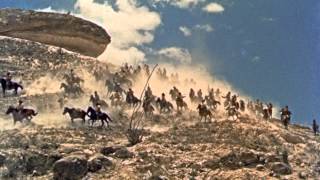
This exciting and colorful 3D film was released 50 years ago this week and remains an enjoyable action adventure today. With its distinctive peppermint-striped titles, the movie is one of John Wayne's best westerns and he happens upon a young woman at her isolated ranch and warns her of the threat of Indian uprisings. There is tension between the dispatch rider and the woman at first but she also knows that her son enjoys the man's presence on their ranch. Ward Bond and James Arness are the best-known cast members, and Geraldine Page, in her first movie, received an Academy Award nomination for her work in this film. The battle scenes are exciting, a series of hit-and-run cavalry-Indian fighting under bright blue skies and thick, fluffy clouds. The sound effects during the battles, of bullets and arrows hitting home are realistic and superb. The movie was filmed in Camargo, Mexico, an arid desert country studded with isolated, cone-shaped mesas. The music score by Hugo Friedhofer is among his best work.
John Wayne as cavalry scout and protecting a defenseless widow and her son against Apaches
This exciting Western was released in three dimensional (3-D with some gimmickry) in the 50's, a highly topical exhibition mean , nowadays being successfully going back and including polarized glasses. It was the time when introduced Cinemascope and 3-D to compete with TV and attract people to movie theaters . It deals with Hondo Lane (John Wayne) , a scout for the US cavalry, he meets Angie Lowe (Geraldine Page)and falls in love with her , in this typical and entertaining western of the the 50's . The drumbeats of the Apaches sound a grim warning to a woman living in an isolated farm with her son . Hondo Lane becomes stubborn guard Angie Lowe (Geraldine Page in her first movie character) alarmed about the pending Indian uprising and then he turns into a figure father to her son named Johnny. The homesteader Angie, decided to await the return of his gruff husband, refuses to leave his property in spite of the imminent danger from a nearby Indian tribes. The woman living in the wilderness presumes she is safe because the Apaches (led by Michael Pate and Rodolfo Acosta) , under their leader Vittorio, have always left them alone. Later Lane has a run-in with Angie's reprobate husband (Leo Gordon) and is forced to murder in self-defense, not knowing who he is. Vittorio (Michael Pate) captures Lane and to save his life, Angie tells the Apache chief that Lane is her husband, unaware that Lane has murdered her real husband. In order to protect her from a forced marriage with one of the Apache, Lane reluctantly goes along with the lie and both of them fend off the violent Indians . This classic western contains thrills , action , fights , brawls , impressive battles and spectacular scenarios . Wayne interpretation is the major plus , he's frankly sensational and awesome. This picture, being filmed in 3-D scenery and that it more attractive and impressive look for the legendary John Wayne whom was a novelty the shooting in this system. Interesting screenplay by James Edward Grant , Western's usual writer , though results to be a variation on ¨Shane¨. The film is a well-made Western with a fine result, a colorful photograph and an enjoyable love story . Furthermore , it shows a human view of the Indians and their relations to the American west settlers. This apparently unknown western was nominated for two Academy Awards, a nomination prize for the magnificent acting by Geraldine Page (her first nomination in her long career), and another for Louis L'Amour, well-known writer of novels set on the wild west. Glamorous and glimmer cinematography in superb Technicolor by Robert Burks (Hitchcock's ordinary) and Archie Stout . Lively and sensible musical score by Hugo Friedhofer . The motion picture is compellingly directed by John Farrow (Big clock , Wake Island , Copper cannon ,Captain Jones , among others) . The film was restored by the John Wayne Society for re-release in 1995 and todays is considered as the Duke at his best . Followed by a short-lived TV series . Rating : Above average .Worthwhile watching and a John Wayne's favourite .